How Chaka Production combines AI-assisted stem separation, musical interpretation, and professional audio production to recreate instrumental tracks while preserving the original background vocals.
When Vocal Removal Is Not Enough
Recently, Chaka Production received an inquiry from a client who needed instrumental versions of six songs while retaining the original background vocals (BGVs).
At first glance, this might sound like a straightforward vocal removal project. Today, AI-powered vocal separation tools make it relatively easy to extract vocals and instrumentals from an existing audio file.
However, there is a limitation.
When separating audio from compressed MP3 or MP4 sources, particularly recordings sourced from YouTube, the resulting instrumental tracks can suffer from noticeable audio artifacts. Some frequencies may disappear, certain instruments can sound unnatural or hollow, and vocal remnants may still be audible.
In some cases, the separation process can also introduce artifacts that affect the overall musical experience.
For this project, simply removing the lead vocal was not going to deliver the quality the client expected.
Instead, I proposed a different approach: reproducing the instrumental arrangements while preserving the original background vocals.
A Hybrid Workflow: AI-Assisted Production and Human Musicianship
The project began with AI-assisted audio analysis.
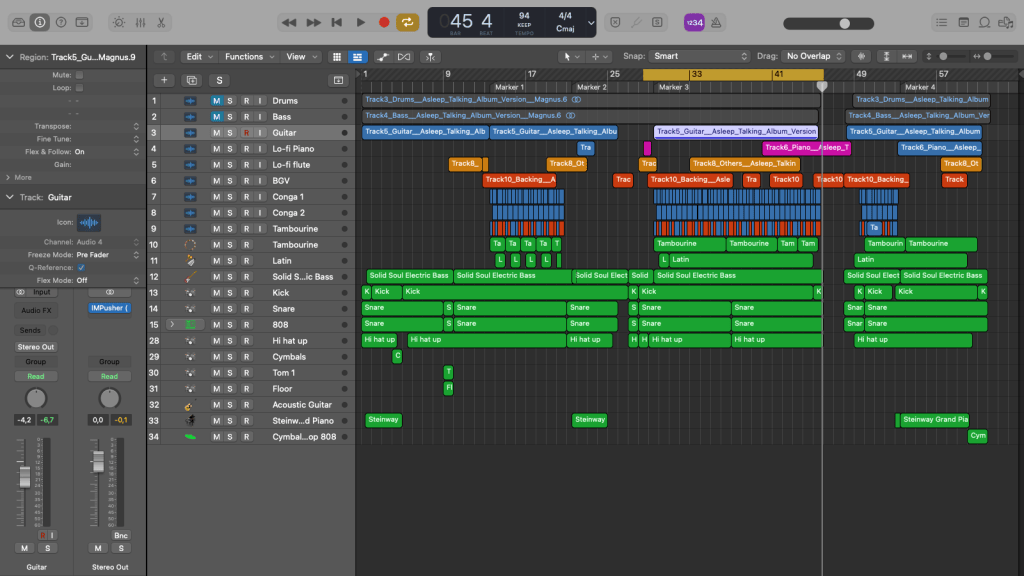
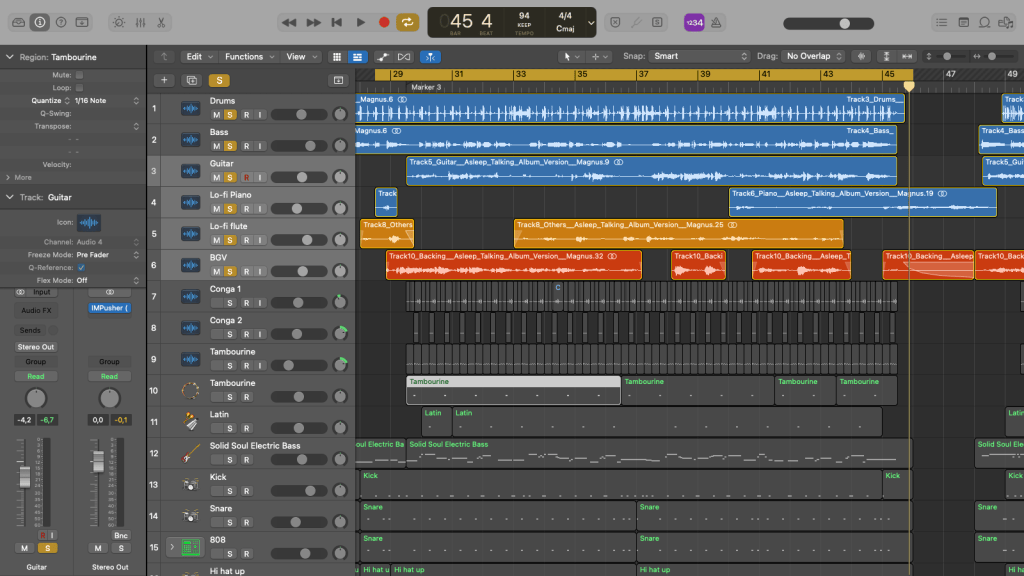
I used AI tools to identify the tempo and separate the original recordings into individual stems. These separated tracks became references for reconstructing the arrangements.
Not every stem needed to be recreated from scratch.
Some elements, including background vocals, guitars, and flute parts, were retained from the original recordings where their quality was suitable.
The remaining instruments were recreated using virtual instruments (VSTs) inside Logic Pro.
My objective was not to create an entirely new interpretation, but to get as close as possible to the original sound, tone, and musical character.
This required careful attention to instrument selection, articulation, dynamics, arrangement details, and sound design.
The idea was simple: preserve the musical identity of each song while achieving a cleaner and more natural-sounding instrumental production.
Six Songs, Six Days
One of the interesting aspects of this project was the turnaround time.
I completed six songs across six different musical genres in just six days.
Rather than working on one song from beginning to end before moving to the next, I developed the arrangements progressively, working on different tracks in parallel.
The flexibility of modern production technology made this possible.
I could access project files, references, and production materials whenever an internet connection was available. Some of the work was done while travelling in a vehicle, during spare moments between other activities, and even late at night before going to sleep.
Of course, the actual recording, programming, editing, and mixing still required focused studio work. But having a portable digital workflow made the production process considerably more flexible.
Professional Delivery and Client Satisfaction
Once all six tracks were completed, I organized the deliverables and uploaded everything to Google Drive.
The client received:
- MP3 preview files for convenient listening.
- Individual instrument stems in WAV format.
- Organized audio files ready for further production or use.
Meeting the deadline was particularly satisfying, especially considering the number of tracks and the variety of musical styles involved.
Even better, the client was happy with the results and voluntarily offered to leave a review.
For me, that is one of the most rewarding parts of working in music production: delivering a solution that genuinely addresses the client’s needs.
AI Is a Tool. Musical Judgment Still Matters.
This project demonstrates how AI can become a valuable part of a modern music production workflow.
AI helped accelerate tempo detection, stem separation, and the initial analysis of the recordings. However, producing a convincing result still required musical understanding, sound selection, arrangement decisions, and careful reconstruction.
Technology can make certain processes faster, but it does not automatically guarantee a musical result.
At Chaka Production, we believe the best approach is to use technology where it helps, while maintaining human musical judgment throughout the production process.
Need instrumental reproduction, backing tracks, or custom music production?
Chaka Production provides music arrangement, instrumental reproduction, audio editing, mixing, mastering, and professional recording services for clients in Indonesia and internationally.
Visit ChakaMusic.com to explore our music production services.